
Season round-up
Why Oxfordshire's 2026 wasp season ran a month late
Last year our kit was packed away by the start of October. This year we were still treating nests in the last week of the month. Here's why, and what it means for you.
By the Wasp Nest Removal Oxfordshire team · · 3 min read
Home / Wasp season blog / Late 2026 season
The short version
- The season ended about a month later than in 2025, with nests still active into the last week of October.
- A warm September and early October kept colonies foraging well past the usual point where they break down.
- It was also a quiet year: around 30% fewer nests than normal, after a cold mid-May spell hit the queens.
- New queens are now looking for places to hibernate. A single large wasp indoors over winter is usually one of them, not a sign of a nest.
In 2025, our equipment was cleaned and packed away by the first week of October. This year we were still out treating nests across Oxfordshire in the last week of the month. A wasp season that started quietly ended up running about a month later than last year's.
A slow start
For most of the summer it was a quiet year. We treated roughly 30% fewer nests than in a typical season, and about half as many as in 2025, which was exceptionally busy. Other pest controllers around the country saw the same.
The cause goes back to May. A warm, dry start to spring brought queens out of hibernation to start their nests. Then in mid-May, northerly winds brought cold, showery days and a risk of frost in rural areas. A queen builds her first nest alone and has to forage for herself, so a spell like that at the wrong moment finishes off a lot of nests before they've started. Professor Seirian Sumner, who studies wasps at UCL, wrote in September that the cold, damp weather after a warm spring may have caused many queens to die or abandon their nests.
In our experience a spring cold snap like this happens roughly one year in four. The clearest sign of it this year was how rarely we found more than one nest at a property.
A long finish
Normally, colonies start breaking down in the second half of September and are mostly finished by late October. This year the weather held them up.
| Season | 2025 | 2026 |
|---|---|---|
| How busy | Exceptionally busy | Around 30% below a normal year |
| Homes with more than one nest | Common | Unusual |
| Last nest treatments | By the start of October | Into the last week of October |
September was warm right across the country. The Met Office's figures for south-east and central southern England show it 2.4°C above the long-term average. Early October then brought temperatures in the low 20s, well above the month's average daily high of 13.1°C. With warm afternoons and plenty of late fruit about, the colonies that had survived the spring kept foraging for weeks longer than usual.
Why late wasps can be more of a nuisance
By autumn a colony has stopped raising young, so the workers lose their usual sugar supply and go looking for it elsewhere, in bins, fallen fruit and drinks left outside. A long, warm autumn means more weeks of that behaviour around gardens and patios.
What it means for you now
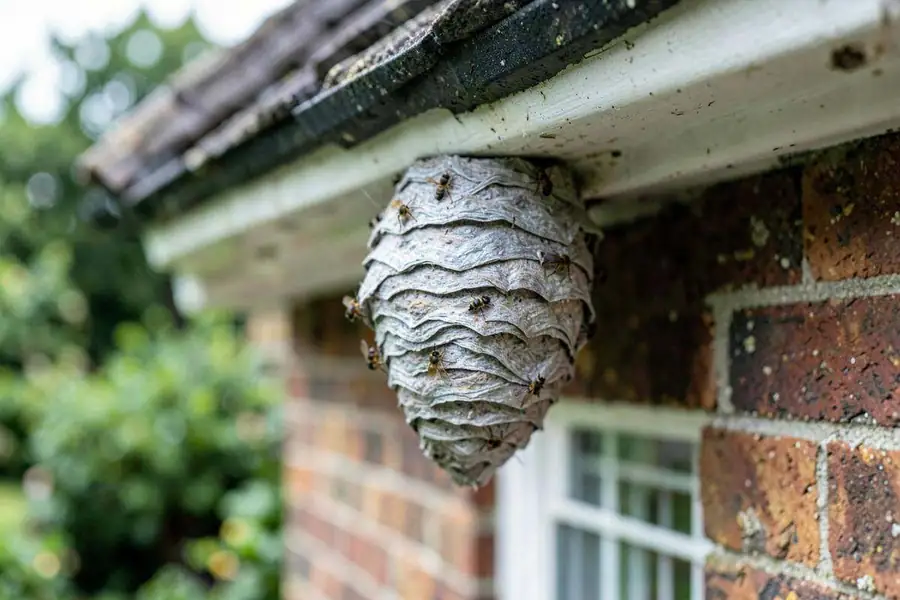
If you still have a nest with wasps flying in and out steadily, it's still live. Whether it's worth treating this late depends on how busy it is and where it is. Our guide on when wasps die off goes through exactly how we judge it, including the calls where we tell people not to bother.
The other thing to know about at this time of year is queens. Each healthy colony raises new queens towards the end of the season, and once they've mated they leave to find somewhere to spend the winter. Sheds, lofts and folded curtains are all common spots. Finding one large, sleepy wasp indoors in November or December is normal and doesn't mean there's a nest in the house.
What we're telling customers
Once a nest is definitely finished, leave it be. Wasps never reuse an old nest. Then, over the winter, look at where they were getting in. A gap in the soffit or a missing bit of mortar that suited this year's queen will suit next year's too. Our prevention guide covers what's worth sealing.
Looking ahead
Whether 2027 is busy or quiet will be decided by the winter and, above all, by the weather next spring. We'll post again when the first queens appear, with what we're seeing across Oxford, Abingdon, Witney and the rest of the county. In the meantime, if you've got a nest that's still busy, or you're not sure about one you've found, message us on WhatsApp or give us a call.
Sources
- Met Office – September 2026 weather stats: a regional breakdown
- LADbible – Why October has felt so warm in the UK, with comment from the Met Office (7 October 2026)
- Met Office – 10-day trend: Will the cold May continue? (13 May 2026)
- ScienceDaily / The Conversation – Wasps are disappearing this summer, and scientists are worried (Prof Seirian Sumner, UCL, 11 September 2026)
Questions we get asked
- Why are there still wasps about in late October?
- Because this autumn has been unusually warm. Wasps keep working while temperatures stay up and there's food around, so some colonies carried on for weeks longer than usual. Most will be finished once nights turn consistently cold.
- Is it worth treating a nest this late in the year?
- It depends how busy it is and where it is. A nest with steady traffic near a door or a path can still be worth treating. One that's gone quiet usually isn't. Our when do wasps die off guide explains how to judge it, and we'll tell you honestly on the phone if it's not worth paying for.
- I've found one big wasp indoors in November. Is there a nest?
- Usually not. In late autumn, newly mated queens look for sheltered spots to hibernate, sometimes in lofts, sheds or behind curtains. One large, slow wasp on its own is most likely a queen, not a sign of an active nest.
- Will the late season mean more wasps next year?
- Nobody can say yet. Next year's numbers depend on how many queens survive the winter and on the weather next spring. This year shows how much one cold spell in May can change things.
- When should I check for a new nest next year?
- From April to early June, when queens are building. A queen flying in and out of the same gap at the eaves or roof line is the sign to look for. Our signs of a nest guide shows what to watch for.
Related guides
Wasps causing a problem?
Same-day treatment across Oxfordshire for a fixed price, with a free revisit if it's needed.
Call 01865 477311