
Wasp behaviour
When do wasps sleep?
Wasps don't sleep under a duvet, but they do switch off. Understanding when a colony rests, when it works, and when it defends helps explain why timing matters for safe, effective treatment.
Message us on WhatsApp for the fastest response. A photo is useful but not required — we have treated every nest type and location countless times.
Appointments available today
- 4.8 on Google
- Same-day service
- Best price locally, fully guaranteed
- Free revisit guarantee
2,000+
Nests treated
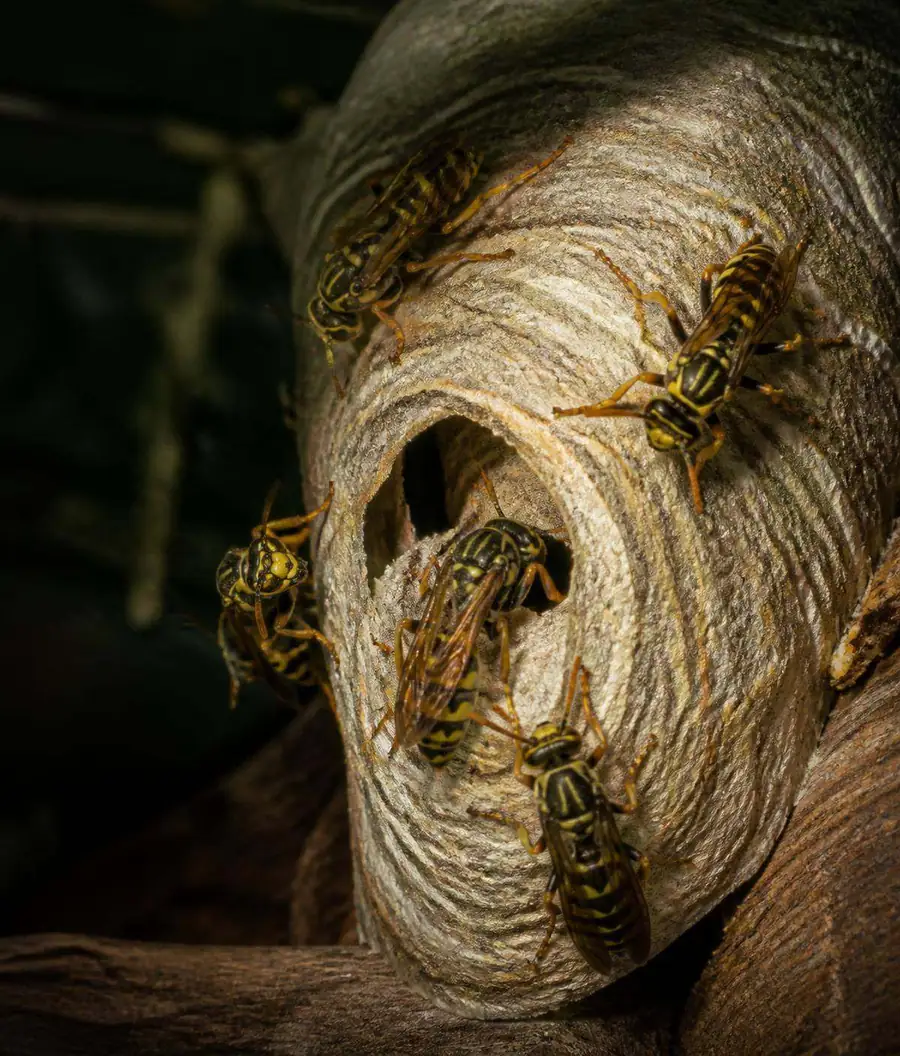
One of the most common questions we hear after dark is: "If I wait until tonight, will the wasps be asleep?" The short answer is that they will be far less active, but they are not unconscious. A wasp nest at night is like a quiet house rather than an empty one — the occupants are still inside, and they can still respond if something disturbs them.
What "sleep" means for a wasp
Wasps do not have eyelids, they do not lie down, and they do not experience REM sleep. What they do have is a strong circadian rhythm driven by light and temperature. During daylight, workers forage, build, feed larvae and defend the nest. After dusk, most return to the nest, reduce movement, lower their metabolism, and become far less reactive. Scientists call this a quiescent or resting state rather than true sleep.
This rest is enough that a nest can look almost silent on a cool evening. Tap the wall nearby and you may hear nothing. Shine a torch at the entrance and only a few heads poke out. That calm is useful, but it is not a guarantee of safety — a direct vibration or bright light close to the nest can still trigger a defensive response.
| Time | Typical activity | What it means for you |
|---|---|---|
| Dawn (5–7am) | Cool and quiet; workers start moving only as the air warms | A good time to observe the entrance without provoking many wasps, but not warm enough for treatment in early season. |
| Mid-morning (9–11am) | Foraging begins in earnest; workers leave to hunt and gather wood fibres | Activity becomes visible; you can often spot the flight path to and from the entrance. |
| Midday (12–3pm) | Peak activity on warm, sunny days; highest number of workers in and out | Best visibility for locating the nest, but also the highest defensive risk if you get close. |
| Late afternoon (4–6pm) | Foraging slows; workers return with food and building material | Still active, but the colony is beginning to settle. |
| Dusk (7–9pm) | Most workers back inside; movement and aggression drop sharply | The preferred window for professional treatment — more targets inside, calmer response. |
| Night (after 9pm) | Resting state; very little flight unless disturbed | Quiet, but never treat a nest yourself at any time of day. |
Why professional treatment often happens at dusk
We frequently schedule wasp nest treatments in Oxfordshire for early evening, especially for nests in busy locations — pub beer gardens, school gates, domestic doorways and shopfronts. The reasons are practical:
- More wasps are inside the nest, so the treatment reaches the maximum number of workers and the queen.
- Lower activity means fewer wasps in the air while the technician is working, reducing the chance of stings to bystanders.
- Cooler temperatures make wasps slower to react, giving the treatment time to work before a coordinated defence builds up.
- Public and commercial sites are quieter, so disruption is minimal.
Telescopic poles let us keep distance even at dusk
The vast majority of Oxfordshire wasp jobs are completed from the ground using long telescopic poles. Ladders are rarely needed. That matters at dusk too — steady footing and good light are easier to manage when both hands are free and the technician is not climbing.
Weather matters more than the clock
A grey, rainy afternoon in June can leave a nest almost as quiet as a dry midnight. Conversely, a hot, humid evening in August can keep workers active long after sunset. Temperature and light together drive behaviour more than the hour alone. This is why we sometimes move an appointment by a couple of hours if the weather shifts — a calm, cool evening is simply a better treatment window than a warm, windy one.
Seasonal shifts in rest patterns
In spring, a nest may contain only a handful of workers and a queen. They rest whenever the temperature drops, and the whole colony can look dormant on a cold morning. By August, thousands of workers share the same nest structure, and the warmth generated by the colony itself keeps some activity going even after dark. In autumn, as the old queen dies and workers lose their larvae to feed, late-season wasps become less predictable — they may be sluggish by day but still active around fruit, bins and sugary drinks.
What to do if wasps are keeping you awake
If buzzing in a wall cavity or loft is disturbing your sleep, the noise is almost certainly daytime activity echoing through quiet rooms, or a nest positioned against a bedroom ceiling. The wasps themselves are not nocturnal, but paper-thin plaster and timber can carry sound. Closing vents, drawing curtains and avoiding the area after dark helps, but the only permanent fix is treating the nest.
Don't rely on darkness to make it safe
A dark nest is a quieter nest, not a safe one. Wasps can still sting at night, and a torch or vibration can trigger the same alarm response as daylight disturbance. Leave night-time inspection and treatment to a professional with the right equipment and protective clothing.
Frequently asked questions
- Do wasps sleep at night?
- Not in the way mammals do. Wasps enter a resting, low-activity state at night, with reduced movement and metabolism. They remain in the nest and can still sting if disturbed, but they are far less likely to fly out and investigate noise or light than during the day.
- What time of day are wasps most active?
- Activity peaks in warm, bright daylight — roughly mid-morning to late afternoon on sunny days. Cool, overcast or rainy weather keeps most workers inside, while very hot afternoons can make them more defensive near the nest entrance.
- Is it safe to treat a wasp nest at night?
- Yes, and it is often the preferred time. More workers are inside the nest after dusk, so treatment reaches more of the colony in one visit. The wasps are also calmer and less likely to stream out in response to disturbance.
- Do wasps become more aggressive in the evening?
- Not usually. Evening aggression is a myth. They are generally quieter at dusk. The real risk spikes on hot afternoons, when the nest is crowded and workers are actively foraging and defending the entrance.
- Why do I see wasps around lights at night?
- A wasp near an outdoor light is usually a lost or confused worker attracted to brightness, or a new queen drawn to warmth. It is rarely a sign that the whole nest is active after dark.
- Does cold weather make wasps sleepy?
- Cold weather slows them down dramatically. Below about 10°C most wasps become sluggish and unable to fly well. That is why an early-morning inspection on a chilly day can look calm even when the same nest is busy by lunchtime.
Related guides
We treat nests like this across Oxfordshire
Same-day wasp nest treatment for a fixed £109, including these areas:
Wasps keeping you up?
Whether the nest is active by day or quiet at night, we can treat it safely across Oxfordshire. Fixed price £109, usually same day.
Call 01865 477311