
Wasp facts
Things you didn't know about wasps
Wasps are one of Britain's most disliked insects, but they are also among the most interesting. Understanding a few surprising facts about their biology makes it easier to stay safe and to know when a nest really needs treating.
Message us on WhatsApp for the fastest response. A photo is useful but not required — we have treated every nest type and location countless times.
Appointments available today
- 4.8 on Google
- Same-day service
- Best price locally, fully guaranteed
- Free revisit guarantee
2,000+
Nests treated
Most people only notice wasps when one buzzes round a drink or a nest appears in the loft. But there is far more going on in a wasp colony than the sting. Here are the facts we share most often on call-outs across Oxfordshire — the ones that usually make homeowners pause and look at the nest a little differently.
Only female wasps sting
The stinger is not a weapon in the usual sense; it is a modified ovipositor, the tube female insects use to lay eggs. Because male wasps, called drones, do not lay eggs, they do not have a stinger at all. Every wasp that has ever stung you was a female worker defending the nest.
This matters practically. A wasp nest contains thousands of female workers by late summer, all capable of stinging and all willing to do so if they think the colony is under attack. The males you see in autumn are harmless, but they are vastly outnumbered.
Wasps do not die after stinging
Honey bees leave their barbed stinger behind and die. Wasps do not. Their stinger is smooth and can be withdrawn cleanly, which means a single wasp can sting repeatedly. That is why disturbing a nest can lead to multiple stings in a matter of seconds — the same workers keep coming back.
Wasps make paper from wood
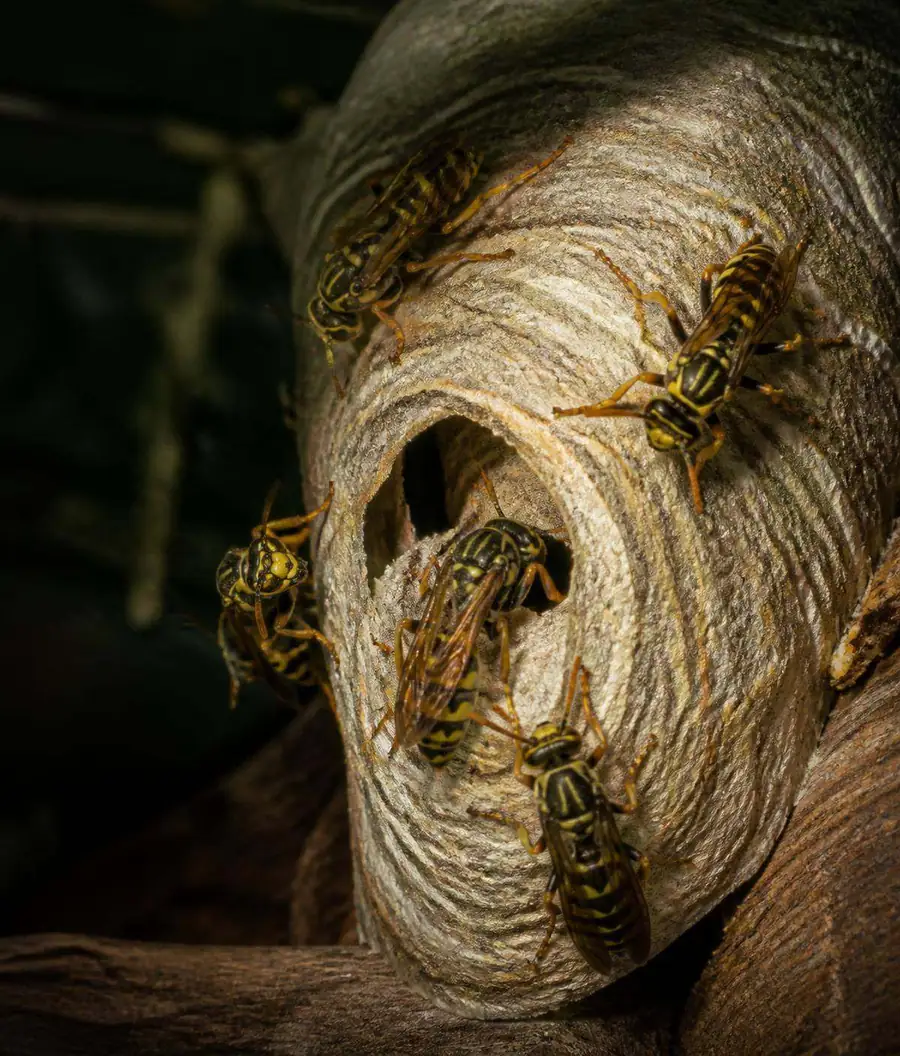
If you see wasps scraping at a garden fence, shed wall or weathered timber, they are collecting fibres. They chew those fibres with saliva and mix them into a grey pulp that dries into the thin, layered paper of the nest. The familiar papery nest is literally recycled garden material.
This is why nests sometimes appear near fences, decking and old outbuildings — the raw material is right there. It is also why a nest can grow quickly once workers are foraging in force.
A nest can grow from one queen to 10,000 workers
In spring a single queen emerges from hibernation, finds a sheltered spot and builds a small nest with a handful of cells. By late summer the same colony can contain 5,000 to 10,000 workers, and occasionally more. The population curve is one reason a small, unnoticed nest in June becomes an obvious problem in August.
Wasps are useful predators and accidental pollinators
Adult wasps feed on nectar and sugary liquids, so they move pollen between flowers while foraging. More importantly, they hunt caterpillars, aphids, flies and other insects to feed the larvae. A healthy wasp population does genuine pest-control work in gardens and farmland.
The problem is not what wasps do in June — it is what happens when the social structure collapses in autumn. Once the queen stops laying, workers no longer have larvae to feed, so they lose their protein source and start searching desperately for sugar.
Wasps can recognise faces
Studies on paper wasps have shown that individuals can recognise each other's faces, much as humans do. This social recognition helps maintain order inside a crowded nest. It is another sign that wasp behaviour is more sophisticated than "fly around and sting things."
The narrow waist is a real anatomical feature
The classic wasp silhouette — a slim thread between thorax and abdomen — is called a petiole, or "wasp waist." It allows the abdomen to bend and flex independently, which helps with stinging, egg-laying and communication inside the nest.
Only mated queens survive winter
As temperatures drop, the old queen, the male drones and the workers all die. Only young, newly mated queens find a sheltered place to hibernate — often in loose bark, roof spaces, sheds or compost heaps — and emerge the following spring to start the cycle again.
This is why finding an old grey nest in winter is rarely urgent. The colony is gone. The risk starts again in spring when a new queen chooses the same cavity or a nearby spot.
Wasps nests are single-use buildings
A wasp colony never moves back into an old nest. The structure is abandoned at the end of the season and will not be reused. If you find an old, dry, silent nest, removal is usually a cosmetic job rather than a live pest issue.
Late-summer aggression is driven by hunger
Wasps are not naturally more aggressive in September; they are hungrier. With no larvae to feed, workers need sugar to survive. That draws them to fruit, bins, drink cans and ice cream. A wasp near your picnic is not defending a nest; it is trying to eat.
Telescopic poles keep most treatments ground-based
The vast majority of wasp nests we treat in Oxfordshire are reached with long telescopic poles from the ground. Ladders are rarely needed, and the technician stays well away from the entrance while applying treatment.
When facts become a reason to call
Knowing that only females sting, that a single wasp can sting many times, and that a colony can number in the thousands does not make a nest more dangerous — it just explains why DIY disturbance can go wrong so quickly. If a nest is in a high-traffic area, near children or pets, or inside a building, professional treatment is the safest route.
Frequently asked questions
- Do male wasps sting?
- No. Only female wasps have a stinger, which is a modified egg-laying tube called an ovipositor. Male wasps, known as drones, cannot sting at all. Their only job is to mate with a new queen.
- Do wasps die after they sting you?
- No. Unlike honey bees, wasps keep their stinger intact and can sting multiple times. This is why a disturbed wasp nest can feel relentless — the same worker can return and sting again.
- What are wasp nests made of?
- Wasps make paper. They scrape fibres from dead wood, garden fences, cardboard and even weathered timber, then chew them with saliva to create a pulp that dries into the thin, grey paper you see in a nest.
- How big can a wasp colony get?
- A common wasp nest in the UK can reach 5,000 to 10,000 workers by late summer, with some larger nests exceeding that. In spring the same nest may have started with just one queen and a handful of cells.
- Are wasps good for anything?
- Yes. Wasps are important pest controllers, hunting caterpillars, aphids and flies to feed their larvae. They also pollinate some plants while feeding on nectar. Their reputation as villains is largely a late-summer problem.
- Can wasps recognise faces?
- Research suggests that some wasps can recognise individual faces within their colony, which helps them manage the complex social hierarchy of a nest. They are far more intelligent than most people assume.
- Why do wasps become more aggressive in late summer?
- By August and September the queen has stopped laying larvae, so workers no longer have a protein source to feed on. They switch to sugary foods, become hungrier, and are more likely to investigate bins, picnics and drinks.
- Do wasps reuse old nests?
- No. A wasp nest is used for a single season. The old queen dies, the workers die off, and only newly mated queens survive winter to start fresh nests the following spring. An old grey nest is usually empty and harmless.
Related guides
We treat nests like this across Oxfordshire
Same-day wasp nest treatment for a fixed £109, including these areas:
Found a nest and not sure what to do?
We treat wasp and hornet nests across Oxfordshire for a fixed £109, usually same day. WhatsApp us for the fastest response — photos are optional.
Call 01865 477311