
Where the nest is: soffits and fascias
Wasp nest in soffits and fascias
It's one of the easiest nests to spot from your own garden — a small dark mark on a white uPVC soffit, with wasps threading in and out of a gap barely bigger than a pencil. Here's what's happening above your gutter line and how we deal with it.
Message us on WhatsApp for the fastest response. A photo is useful but not required — we have treated every nest type and location countless times.
Appointments available today
- 4.8 on Google
- Same-day service
- Best price locally, fully guaranteed
- Free revisit guarantee
2,000+
Nests treated
The soffit is the board running horizontally under the roof overhang, and the fascia is the vertical board it meets at the front edge, usually carrying the guttering. Between them, and behind them, sits the eaves void — the same kind of dry, sheltered gap a loft offers, just a smaller pocket of it. On 1930s-70s houses across Botley, Kidlington and Didcot, and on newer builds in Bicester and Didcot too, this is one of the single most common nest locations we treat, precisely because uPVC soffit boards are jointed in sections and those joints are never perfectly sealed forever.
Two signs that point straight to the eaves
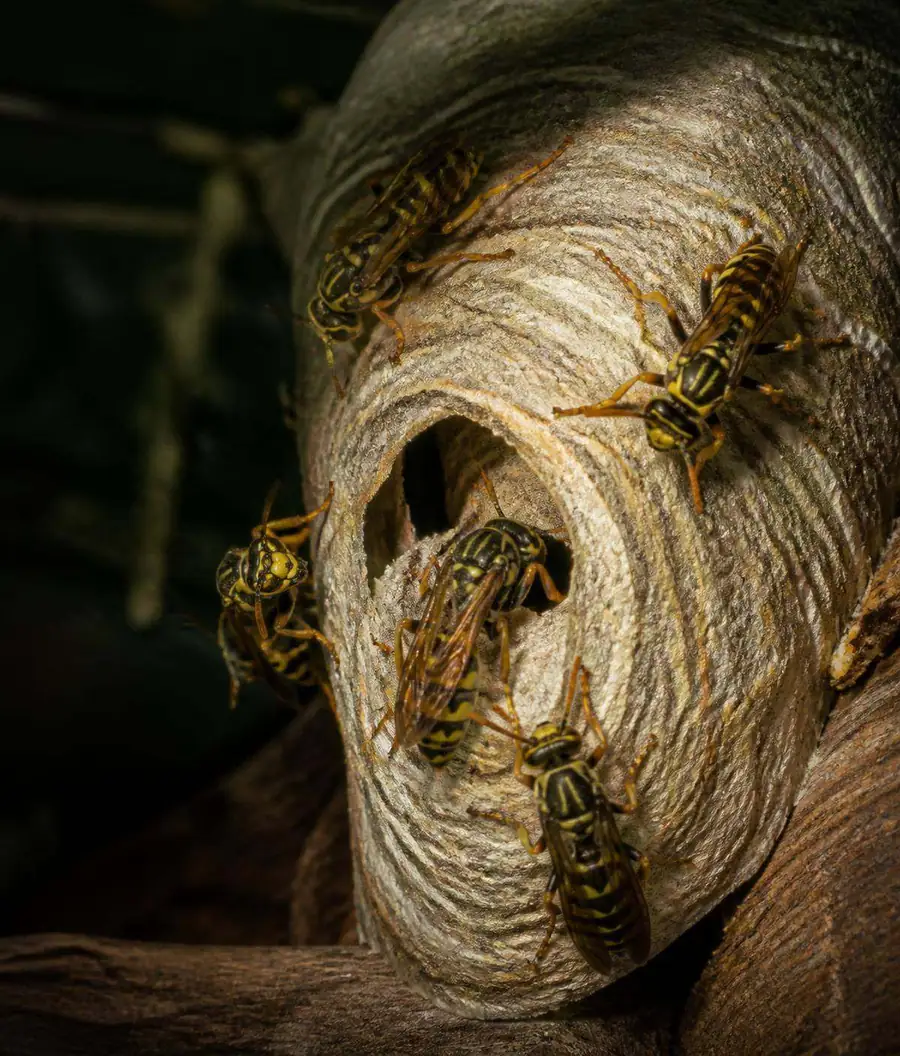
First, watch a stretch of soffit at dusk on a warm day — a repeated, business-like flight path of wasps disappearing into and out of one specific point, rather than milling around generally, means you've found the entry gap. Second, look for staining: a dark, sometimes slightly shiny smudge on white uPVC around that same gap. This builds up gradually as wasps brush the same edge on every trip, so if you see staining plus activity, the nest has usually been established for a few weeks already rather than days.
Not every gap needs a nest to explain it
Occasional wasps investigating a soffit vent without a settled flight pattern don't necessarily mean an established nest yet — sometimes it's a scout queen still deciding. If you're not sure which you're looking at, our signs of a nest guide has more detail, or just call and describe what you're seeing.
Why working at height is the risky part, not the treatment
Treating a soffit nest itself is usually quick, but working at height next to a defensive colony is exactly the kind of job that goes wrong for homeowners — a wobble on a ladder while trying to back away from wasps is a far more likely injury than a sting itself. We treat almost every soffit nest from the ground using telescopic poles, so there's no need for anyone — you or us — to go up a ladder at all.
Do you need to replace the soffit board afterwards
Almost never purely because of the nest. We treat through the existing gap and the nest inside dies off within the void; the soffit board itself is rarely damaged by the wasps' presence. Replacement only becomes worth considering if the board was already warped, cracked, or has vented sections with torn mesh that keep reopening the same access route year after year — in which case it's a conversation for a builder or window/fascia fitter, not us.
- A single, repeated flight path into one gap in the soffit line points to an established nest
- Dark staining on white uPVC around a gap usually means weeks of activity, not days
- Leave anything at height to us — we treat from the ground with telescopic poles, and height plus a defensive nest is the real risk, not the sting itself
- Soffit boards rarely need replacing purely because of a nest that's been treated
- If activity is at ridge height rather than the gutter line, see our roof tiles guide instead
If the wasps you're watching are entering higher up near the ridge rather than at gutter height, you're more likely looking at a nest under the roof tiles. And if the activity seems to be going further in, up into the roof void itself rather than staying in the eaves pocket, our loft nest guide is the better read. Either way, general gap-sealing advice for once a nest is confirmed dead is on our prevention page.
Frequently asked questions
- Why does staining appear on my white uPVC soffit?
- A dark, slightly greasy-looking smudge around a small gap usually builds up from wasps repeatedly brushing past the same entry point over weeks, sometimes mixed with fine debris from the nest itself. It's a strong sign of an established, not brand-new, nest.
- Do I need to replace the soffit board once the nest is gone?
- Not usually for treatment purposes — we treat through the existing entry gap. Replacement only comes up if the board itself is damaged, warped or has multiple failed joints that keep letting wasps back in year after year.
- Can I reach the eaves myself with a ladder and spray it?
- We'd strongly advise against it. Eaves height plus a defensive nest is a genuinely bad combination for a fall, and shop aerosol sprays often just aggravate the colony rather than dealing with it fully.
- Is the entry point always at a joint between soffit boards?
- Most commonly yes — the join between two lengths of soffit, or the corner where soffit meets fascia, opens up slightly over time and gives just enough of a gap. Vented soffit strips with damaged mesh are the other common route.
- Will the nest damage the soffit or roof structure?
- The nest itself doesn't usually cause structural damage, but a long-neglected gap can let in rain as well as wasps over successive seasons, which is worth mentioning to a builder once the nest is dealt with.
- How quickly can you treat a soffit nest?
- This is one of our most common same-day jobs, since treatment from ground level with a telescopic pole is usually straightforward once we know which gap is being used.
Related guides
We treat nests like this across Oxfordshire
Same-day wasp nest treatment for a fixed £109, including these areas:
Nest active? Don't leave it.
Spotted staining or activity on your soffit line? We treat it from the ground with telescopic poles — same-day appointments for a fixed £109.
Call 01865 477311