
Myth-busting comparison
Wasps vs hornets: what's actually different
Something the size of your thumb, flying at dusk with a deep, low drone — most callers assume the worst. Here's what genuinely separates a hornet from a wasp, and which of the scary stories are true.
Message us on WhatsApp for the fastest response. A photo is useful but not required — we have treated every nest type and location countless times.
Appointments available today
- 4.8 on Google
- Same-day service
- Best price locally, fully guaranteed
- Free revisit guarantee
2,000+
Nests treated
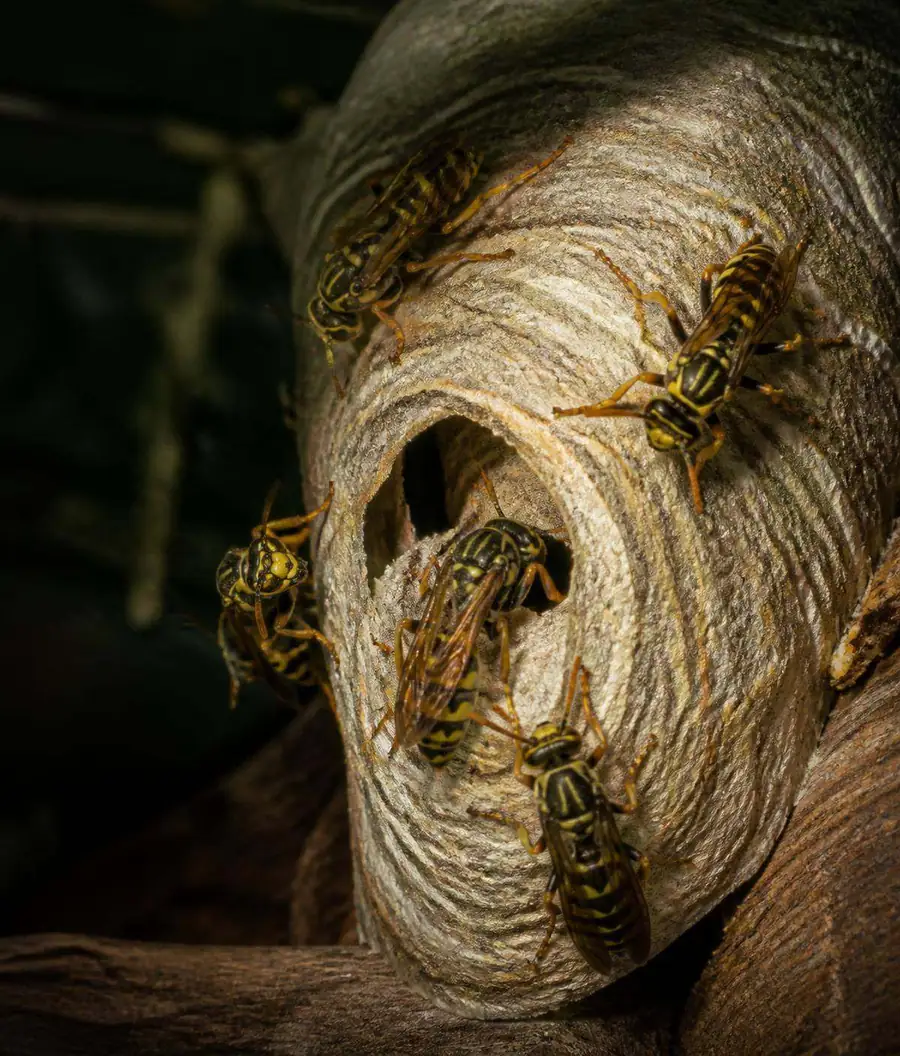
Every August we get calls describing a "giant wasp" that turns out to be a European hornet, and just as often calls about a "hornet" that on inspection is a perfectly ordinary common wasp caught in bad light. The confusion is understandable — but the two insects differ in size, sound, colour, nesting habits and, contrary to reputation, temperament.
Myth: hornets are more dangerous than wasps
This is the biggest misconception we hear. European hornets are, if anything, calmer and less prone to stinging without real provocation than the common wasp. Their reputation comes almost entirely from their size and the loud, deep buzz of their flight, which understandably unsettles people. A single sting delivers more venom and is more painful, but is not inherently more medically dangerous to a non-allergic adult than a wasp sting.
| Feature | Common/German wasp | European hornet |
|---|---|---|
| Length | 12-17mm | 25-35mm |
| Colour | Bright, sharp yellow and black | Duller red-brown thorax, yellow abdomen with brown markings |
| Flight sound | High-pitched buzz | Deep, heavy drone, audible from further away |
| Activity pattern | Daytime only | Active after dark, drawn to lit windows |
| Nest sites | Lofts, sheds, hedges, underground | Hollow trees, loft voids, wall cavities, rarely underground |
| Temperament near nest | Defensive, quick to respond | Generally calmer, but will defend the nest if provoked |
| Typical colony size | Several hundred to a few thousand | A few hundred, occasionally more |
Myth: hornets travel in this country to attack people
European hornets forage individually, just like wasps, and are not aggressive toward people going about their business in a garden. They will investigate light sources at night out of simple attraction to light, not because they're hunting anyone. Panic swatting is far more likely to provoke a sting than the hornet's own behaviour.
Sound and sight: the fastest field test
Before you get close enough to compare markings, listen. A hornet's flight has a noticeably deeper, heavier tone than a wasp's higher buzz, largely because of its size. Visually, look at the thorax — hornets have a reddish-brown thorax and head rather than the sharp black-and-yellow of a wasp, giving them a duller, more muted overall colour even though the abdomen still carries yellow banding.
One important exception: the Asian hornet
Everything above concerns the European hornet, which is native and, while intimidating, not a serious concern. The non-native Asian hornet is a different matter — smaller, darker, with distinctive yellow leg tips, and a genuine threat to honeybee colonies. If you think you've seen one, don't treat it yourself: read our Asian hornet identification and reporting guide first.
When to actually worry
The real risk factor with either insect is a nest near a doorway, patio or children's play area, or a known sting allergy in the household. Size and species matter less than location and how many stings a disturbance could cause. See our sting allergy guide for symptoms that need urgent medical attention.
- Loud, deep drone and dusk/night activity — likely a European hornet, not a wasp.
- Sharp yellow-and-black, high-pitched buzz, daytime only — a common or German wasp.
- Pale yellow leg tips and a mostly dark abdomen — stop and check our Asian hornet guide.
- Nest in a hollow tree or old loft void, calm insects — probably European hornet, low urgency.
- Nest near a door, patio or play area, whatever the species — treat as a priority.
For more on the European species specifically — including whether a hornet nest even needs treating — see our dedicated European hornet guide, or head back to our full species overview.
Frequently asked questions
- Is a hornet sting worse than a wasp sting?
- It's more painful at the moment of the sting because the stinger is larger, but the reaction it causes in most people is comparable to a wasp sting. Neither is more medically dangerous unless you're allergic, in which case any sting is a medical emergency.
- Are hornets more aggressive than wasps?
- The opposite, generally. European hornets are noted for being calmer and less likely to sting unprovoked than common wasps, despite their frightening size and loud flight.
- Why do hornets fly at night?
- European hornets are unusual among UK social wasps in that they forage after dark and are strongly attracted to outdoor lighting, security lights and lit windows in summer.
- Do hornets die if they sting you, like honeybees?
- No. Like wasps, hornets have a smooth, retractable stinger and can sting repeatedly without harming themselves.
- How big is a hornet nest compared to a wasp nest?
- A mature hornet nest can be considerably larger than a wasp nest, sometimes exceeding half a metre, though hornet colonies typically contain fewer individuals than a large wasp colony.
- Can I use the same off-the-shelf spray on a hornet nest as a wasp nest?
- We'd strongly advise against DIY treatment of either, but hornet nests are more often high up in mature trees or in awkward loft voids, making a confident, safe DIY treatment even less realistic.
Related guides
We treat nests like this across Oxfordshire
Same-day wasp nest treatment for a fixed £109, including these areas:
Nest active? Don't leave it.
Wasp or hornet, high up in a tree or tucked in a loft — we treat both, safely, for a fixed £109.
Call 01865 477311